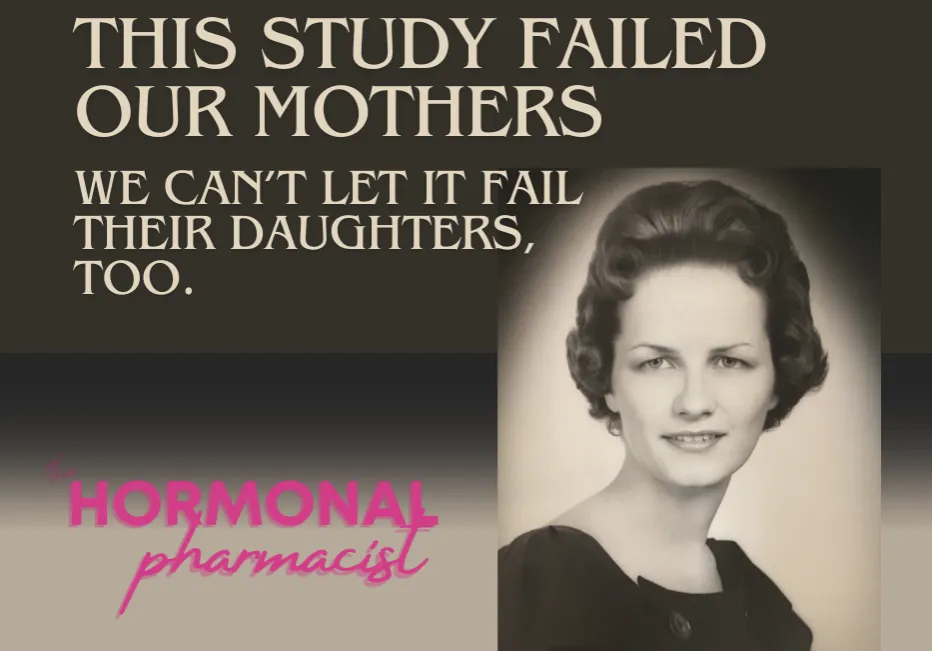
This Study Failed Our Mothers
In the 1960s, women looked forward to their golden years with optimism. They were vibrant, strong, and full of life. But as they aged, many of them faced an uphill battle—one they shouldn’t have had to fight.
Because of one study.
The Women’s Health Initiative (WHI) is one of the most damaging medical studies ever conducted when it comes to women’s health. Published in 2002, it single-handedly derailed hormone therapy for an entire generation. It spread fear instead of facts, leading to millions of women being denied the very treatment that could have protected them from heart disease, osteoporosis, cognitive decline, and more.
And I take it personally.
My mother was one of those women. She was told that hormone therapy was dangerous. That it would give her breast cancer. That she just had to suffer through aging and accept the consequences.
And it was all based on deeply flawed science.
The WHI: A Study Built on Misconceptions and Misinterpretations
The WHI initially reported that hormone therapy increased the risk of breast cancer, heart disease, and stroke. Overnight, prescriptions for estrogen plummeted. Women were scared. Doctors were scared. But what they failed to emphasize was this:
The women in the study were, on average, 63 years old—well past the age when hormone therapy is most protective. They were not newly menopausal women who would have benefitted from early intervention.
The type of hormones used in the study were synthetic and not bioidentical. We now know that formulations matter—bioidentical estradiol and progesterone have vastly different effects than synthetic counterparts.
Later reanalysis showed that younger women (50–59) who started hormone therapy closer to menopause actually had a lower risk of heart disease and mortality. But by then, the damage was done.
This misinformation led to millions of women being denied the care they needed. Doctors were (and still are) hesitant to prescribe hormones. Women were told to “tough it out.”
And the result? More heart disease. More osteoporosis. More cognitive decline. More unnecessary suffering.
The Lasting Damage—and Why We Must Fix It
The generation before us was failed. And what makes me furious is that many healthcare providers still haven’t caught up with the updated research.
Women today are still being told that hormone therapy is dangerous, when in reality:
Estradiol is heart-protective. It helps keep blood vessels flexible, reduces inflammation, and improves cholesterol levels.
Progesterone isn’t just for the uterus. It supports brain health, mood stability, and sleep quality.
Testosterone improves cardiac output and metabolic function, keeping women strong and energized.
We now have two decades of research overturning the WHI’s conclusions.
The Time to Change the Narrative Is NOW
If you’re a healthcare provider, I urge you to look at the research we have today.
The WHI was flawed. Women in their 50s and early 60s benefit from hormone therapy.
The risk of breast cancer with estrogen-only therapy?
Lower than in women who don’t take it.
The risk of heart disease?
Reduced when therapy is started early.
If you’re a woman navigating perimenopause or menopause,
advocate for yourself.
Challenge outdated narratives.
Ask for bioidentical options.
Demand that your providers stay informed, and make sure your HRT is being managed by someone that knows what they are doing.
Traditionally trained doctors don’t get hormone education specific to perimenopause—a 2017 survey found that 80% of medical residents reported receiving little to no training on menopause management.
And this is the reason why many physicians, NPs, and PAs will say, “I don’t do hormones.” Not necessarily because they don’t trust them—because honestly, there’s enough research to prove they are safe. But more often, it’s because they don’t know how to manage them and dose them.
And that’s OK.
I can’t do what they do. It is their job to diagnose and treat disease.
That’s where a functional medicine practitioner comes in.

It is my purpose to prevent disease from happening, and when it does, to find out WHY it’s happening and to support your body in every other way possible.
I work as a team with your prescriber.
I went back to get my functional medicine certification so that I would know exactly how to heal myself. And if I will use it on myself, you dang sure better believe that I trust it, believe in it, and know it is safe.
Our mothers were misled.
We owe it to them—and to ourselves—to get this right.
We know better now.
Let’s do better.